
Basic Spanish phrases for travel
27 phrases · pronunciation · audio
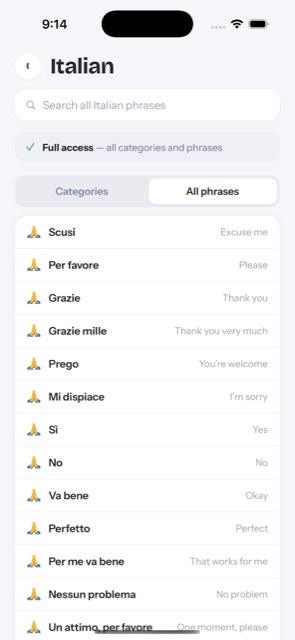
Heading to Spain? These are the 27 phrases worth knowing before you land. The greetings and small courtesies that come up on day one, starting with “Hola”. Every one shows how it's written, how to say it, and has audio you can play.
Everything below is Spanish as it's said in Spain — the wording, the pronunciation guide and the audio. The switch above has the Latin America version.
These are free here and free in the app, in every language. Nothing to sign up for.
Essentials
-
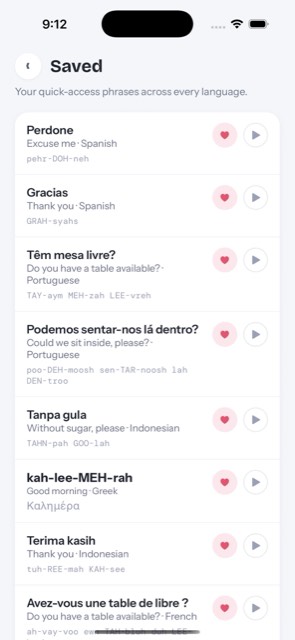
Excuse me
Perdone
ESpehr-DOH-neh
Use it to get someone’s attention before a question, or to squeeze past on a crowded metro.
The polite way to catch a stranger’s attention. “Disculpe” works identically.
- Also common Disculpe dees-KOOL-peh
-
Please
Por favor
por fah-VOR
Add it to any order or request.
-
Thank you
Gracias
GRAH-thyahs
Say it after any small service, such as a waiter bringing a dish or a shopkeeper handing over change.
-
Thank you very much
Muchas gracias
MOO-chahs GRAH-thyahs
Use it when someone has gone out of their way to help and you want to show extra gratitude.
-
You’re welcome
De nada
deh NAH-dah
Use it after someone thanks you. “No problem” is a more casual alternative.
-
I’m sorry
Lo siento
loh SYEN-toh
Use it to apologise when you’ve made a mistake or caused someone trouble.
-
Yes
Sí
see
Useful for confirming a price or accepting an offer.
-
No
No
noh
Use it to turn down an offer or an extra you didn’t ask for.
-
Okay
Vale
ESBAH-leh
Use it to agree to a plan, a price, a meeting time or a pickup point.
“Vale” is the everyday okay in Spain, you’ll hear it constantly.
-
Perfect
Perfecto
pehr-FEHK-toh
A warmer “okay” for when a suggestion suits you.
-
That works for me
Me parece bien
meh pah-REH-theh byen
Use it to accept a suggestion, such as a later table or a different room.
-
No problem
No hay problema
noh eye proh-BLEH-mah
Use it when someone apologises to you, or to wave off a small inconvenience.
-
One moment, please
Un momento, por favor
oon moh-MEN-toh por fah-VOR
Buy yourself a few seconds at the counter while you find your wallet or decide what to buy.
-
Could you help me, please?
¿Me puede ayudar, por favor?
meh PWEH-deh ah-yoo-DAR por fah-VOR
The polite way to open a request for assistance.
Greetings
-
Hello
Hola
OH-lah
An everyday greeting polite enough for staff and strangers. One of the first things you should learn in any language.
-
Hi
Buenas
BWEH-nahs
The casual “hello” for friends and anyone you know well.
The relaxed all-day greeting locals use walking into shops and bars, short for “buenas tardes/días”.
-
Good morning
Buenos días
BWEH-nohs DEE-ahs
Use it until around midday when you greet staff in a shop, café or hotel.
-
Good afternoon
Buenas tardes
BWEH-nahs TAR-dehs
For the stretch between lunch and evening. When people switch to “good evening” varies, so follow what locals say to you.
Used from after lunch until roughly 8–9 pm. Spanish afternoons run late.
-
Good evening
Buenas noches
BWEH-nahs NOH-chehs
The greeting for later in the day: walking into a restaurant for dinner, or checking in after dark.
Doubles as “good night”. It greets and bids farewell after dark.
-
Goodbye
Adiós
ah-DYOHS
Say it as you leave a shop or get out of a taxi.
In practice locals often part with “hasta luego” even when they’ll never see you again.
- More casual Hasta luego AHS-tah LWEH-goh
- Like a local Chao CHOW
-
See you later
Hasta luego
AHS-tah LWEH-goh
For people you’ll see again, such as hotel staff or the barista you visit each morning.
-
Have a good day
¡Que tenga un buen día!
keh TEN-gah oon bwen DEE-ah
A sign-off after a short exchange, such as paying in a shop.
-
Take care
Cuídate
KWEE-dah-teh
A friendly goodbye to someone you’ve chatted with, like a host or a shopkeeper who helped you.
“Cuídate” is for someone you’d call “tú”. To a stranger or someone older, say “cuídese”.
- Formal Cuídese KWEE-deh-seh
-
My name is [name]
Me llamo [nombre]
meh YAH-moh [nombre]
It’s useful to introduce yourself in the local language, especially when meeting people during your travels.
-
How are you?
¿Cómo está?
KOH-moh ehs-TAH
Follow your greeting with it. Some people answer briefly, others treat it as a real question.
“¿Qué tal?” is the everyday version you’ll hear most, safe with almost anyone.
- Also common ¿Qué tal está? keh TAHL ehs-TAH
- Casual ¿Qué tal? keh TAHL
-
I’m well, thank you
Bien, gracias
byen GRAH-thyahs
The standard reply to “How are you?”. Ask the question back if you want to continue the conversation.
-
Nice to meet you
Encantado
en-kahn-TAH-doh
A useful phrase when meeting someone new on your travels. Saying it in the local language is a nice touch.
Ends in -o if you’re a man, -a if you’re a woman. “Mucho gusto” is a genderless alternative.
- If you’re a woman Encantada en-kahn-TAH-dah
- Neutral Mucho gusto MOO-choh GOOS-toh
ES marks a phrase that is worded differently in Latin America.
Also in the app
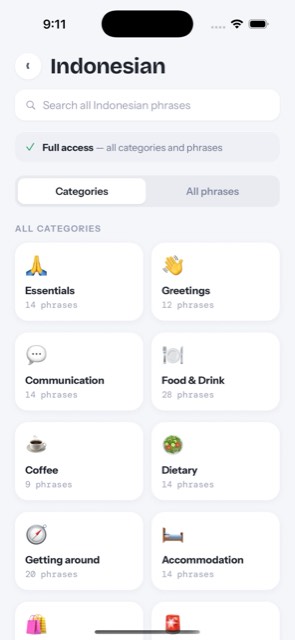
Nine more categories, 133 further Spanish phrases:
- Communication 14
- Food & Drink 28
- Coffee 9
- Dietary 14
- Getting around 20
- Accommodation 14
- Shopping 10
- Emergency 17
- Social 7