
Basic Thai phrases for travel
27 phrases · pronunciation · audio
Heading to Thailand? These are the 27 phrases worth knowing before you land. The greetings and small courtesies that come up on day one, starting with “สวัสดีครับ”. Every one shows how it's written, how to say it, and has audio you can play.
Thai isn't written in the Latin alphabet, so every phrase below also carries a Latin-letter version — labelled RTGS — alongside a plain-English guide to saying it out loud.
These are free here and free in the app, in every language. Nothing to sign up for.
Essentials
-
Excuse me
ขอโทษครับ
RTGS Khothot khrap
kaw-TOHT krap
Use it to get someone’s attention before a question, or to squeeze past on a crowded metro.
Covers both excuse me and sorry. To call over younger staff, Thais say “nong” (younger sibling); “phi” (older sibling) is a friendly, respectful address for anyone older. If unsure, “khothot khrap” always works.
- If you’re a woman ขอโทษค่ะ Khothot kha kaw-TOHT ka
- Calling younger staff น้องครับ Nong khrap nawng krap
- Calling someone older พี่ครับ Phi khrap pee krap
-
Please
กรุณา
RTGS Karuna
gah-roo-NAH
Add it to any order or request.
On its own it sounds unfinished. It opens a request and the polite ending closes it, as in the example. It’s the formal word, used on signs, in announcements and by service staff; in conversation Thais often leave it out and let the polite ending do the work of please, as in “chuai … noi khrap” (could you …) or “kho … noi khrap” (could I have …). Women end with “kha” (ค่ะ), or “kha” (คะ) on a question.
-
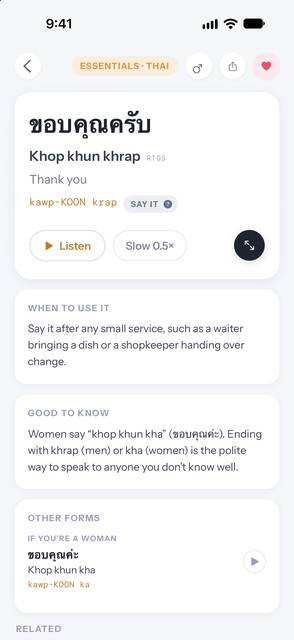
Thank you
ขอบคุณครับ
RTGS Khop khun khrap
kawp-KOON krap
Say it after any small service, such as a waiter bringing a dish or a shopkeeper handing over change.
Women say “khop khun kha” (ขอบคุณค่ะ). Ending with khrap (men) or kha (women) is the polite way to speak to anyone you don’t know well.
- If you’re a woman ขอบคุณค่ะ Khop khun kha kawp-KOON ka
-
Thank you very much
ขอบคุณมากครับ
RTGS Khop khun mak khrap
kawp-KOON mahk krap
Use it when someone has gone out of their way to help and you want to show extra gratitude.
- If you’re a woman ขอบคุณมากค่ะ Khop khun mak kha kawp-KOON mahk ka
-
You’re welcome
ไม่เป็นไรครับ
RTGS Mai pen rai khrap
mai-bpen-RAI krap
Use it after someone thanks you. “No problem” is a more casual alternative.
Literally “it’s nothing”, the everyday reply to thanks. “Yindi” is a more formal “my pleasure”.
- If you’re a woman ไม่เป็นไรค่ะ Mai pen rai kha mai-bpen-RAI ka
- Formal ยินดีครับ Yindi khrap yin-DEE krap
-
I’m sorry
ขอโทษครับ
RTGS Khothot khrap
kaw-TOHT krap
Use it to apologise when you’ve made a mistake or caused someone trouble.
The same word as excuse me. Add “ching ching” (really) for extra emphasis.
- If you’re a woman ขอโทษค่ะ Khothot kha kaw-TOHT ka
- Really sorry ขอโทษจริงๆ ครับ Khothot ching ching khrap kaw-TOHT jing-JING krap
-
Yes
ครับ
RTGS Khrap
krap
Useful for confirming a price or accepting an offer.
Thai has no all-purpose yes. Men answer “khrap” and women “kha” (ค่ะ), which covers yes, I’m listening and okay. Because “khrap” can just mean “I hear you”, a clearer yes repeats the verb of the question: “ao khrap” (I’ll take it), “dai khrap” (I can), “mi khrap” (there is). “Chai” means that’s right.
- If you’re a woman ค่ะ Kha ka
- That’s right ใช่ครับ Chai khrap chai krap
-
No
ไม่เอาครับ
RTGS Mai ao khrap
mai-OW krap
Use it to turn down an offer or an extra you didn’t ask for.
Thai says no by negating the verb. “Mai ao” (don’t want) turns down an offer; “mai chai” (not right) corrects a wrong guess.
- If you’re a woman ไม่เอาค่ะ Mai ao kha mai-OW ka
- That’s not right ไม่ใช่ครับ Mai chai khrap mai-CHAI krap
-
Okay
โอเคครับ
RTGS O khe khrap
oh-KAY krap
Use it to agree to a plan, a price, a meeting time or a pickup point.
“Dai” (can do) is the usual way to agree to a request.
- If you’re a woman โอเคค่ะ O khe kha oh-KAY ka
- Can do ได้ครับ Dai khrap dai krap
-
Perfect
ดีเลยครับ
RTGS Di loei khrap
dee-LUHY krap
A warmer “okay” for when a suggestion suits you.
- If you’re a woman ดีเลยค่ะ Di loei kha dee-LUHY ka
-
That works for me
แบบนั้นได้ครับ
RTGS Baep nan dai khrap
baep-NAN DAI krap
Use it to accept a suggestion, such as a later table or a different room.
- If you’re a woman แบบนั้นได้ค่ะ Baep nan dai kha baep-NAN DAI ka
-
No problem
ไม่เป็นไรครับ
RTGS Mai pen rai khrap
mai-bpen-RAI krap
Use it when someone apologises to you, or to wave off a small inconvenience.
Means no problem, never mind or don’t worry about it. You’ll hear it after apologies, small mishaps and thanks.
- If you’re a woman ไม่เป็นไรค่ะ Mai pen rai kha mai-bpen-RAI ka
-
One moment, please
รอแป๊บนึงนะครับ
RTGS Ro paep nueng na khrap
raw BPAEP neung nah krap
Buy yourself a few seconds at the counter while you find your wallet or decide what to buy.
- If you’re a woman รอแป๊บนึงนะคะ Ro paep nueng na kha raw BPAEP neung nah ka
- Formal สักครู่นะครับ Sak khru na khrap sak-KROO nah krap
-
Could you help me, please?
ช่วยหน่อยได้ไหมครับ
RTGS Chuai noi dai mai khrap
chuay NOY dai MAI krap
The polite way to open a request for assistance.
- If you’re a woman ช่วยหน่อยได้ไหมคะ Chuai noi dai mai kha chuay NOY dai MAI ka
-
No need, thank you
ไม่ต้องครับ
RTGS Mai tong khrap
mai DTAWNG krap
Turns down something offered for your benefit, like a bag or help carrying your luggage.
Literally “no need”. For a warmer no, add thank you: “mai tong khrap, khop khun khrap” (ไม่ต้องครับ ขอบคุณครับ).
- If you’re a woman ไม่ต้องค่ะ Mai tong kha mai DTAWNG ka
Greetings
-
Hello
สวัสดีครับ
RTGS Sawatdi khrap
sah-wat-DEE krap
An everyday greeting polite enough for staff and strangers. One of the first things you should learn in any language.
Works at any time of day, and as goodbye too. Women say “sawatdi kha” (สวัสดีค่ะ). Between adults it often comes with a wai, palms pressed together at the chest. In shops and restaurants a smile and a nod is a fine response to staff.
- If you’re a woman สวัสดีค่ะ Sawatdi kha sah-wat-DEE ka
-
Hi
หวัดดีครับ
RTGS Watdi khrap
wat-DEE krap
The casual “hello” for friends and anyone you know well.
A clipped, friendly form for people your own age or younger.
- If you’re a woman หวัดดีค่ะ Watdi kha wat-DEE ka
-
Goodbye
ไปก่อนนะครับ
RTGS Pai kon na khrap
bpai GAWN nah krap
Say it as you leave a shop or get out of a taxi.
Literally “I’ll go first”, said by the one leaving a chat or a visit. After a quick purchase “khop khun khrap” is usually enough. “La kon” (ลาก่อน) sounds theatrical or final.
- If you’re a woman ไปก่อนนะคะ Pai kon na kha bpai GAWN nah ka
- Casual บ๊ายบาย Bai bai bye-bye
-
See you later
แล้วเจอกันครับ
RTGS Laeo choe kan khrap
laew juh-GAN krap
For people you’ll see again, such as hotel staff or the barista you visit each morning.
- If you’re a woman แล้วเจอกันค่ะ Laeo choe kan kha laew juh-GAN ka
-
Have a good day
โชคดีนะครับ
RTGS Chok di na khrap
chohk-DEE nah krap
A sign-off after a short exchange, such as paying in a shop.
Literally “good luck”, a friendly way to close a conversation. To wish someone a safe journey, say “doenthang plotphai na khrap” (เดินทางปลอดภัยนะครับ).
- If you’re a woman โชคดีนะคะ Chok di na kha chohk-DEE nah ka
-
Take care
ดูแลตัวเองด้วยนะครับ
RTGS Dulae tua eng duai na khrap
doo-LAE tua-AYNG duay nah krap
A friendly goodbye to someone you’ve chatted with, like a host or a shopkeeper who helped you.
- If you’re a woman ดูแลตัวเองด้วยนะคะ Dulae tua eng duai na kha doo-LAE tua-AYNG duay nah ka
-
My name is [name]
ผมชื่อ[ชื่อ]ครับ
RTGS Phom chue [chue] khrap
pom CHEU [cheu] krap
It’s useful to introduce yourself in the local language, especially when meeting people during your travels.
“Phom” is the men’s word for I. Women often drop the pronoun: “chue … kha” (ชื่อ…ค่ะ). Thais go by first names or nicknames, so give your first name.
- If you’re a woman ฉันชื่อ[ชื่อ]ค่ะ Chan chue [chue] kha chan CHEU [cheu] ka
-
How are you?
สบายดีไหมครับ
RTGS Sabai di mai khrap
sah-bai-DEE mai krap
Follow your greeting with it. Some people answer briefly, others treat it as a real question.
A real question about how someone is, best with people you’ve met before. Between people who know each other, “pai nai?” (where are you off to?) and “kin khao rue yang?” (eaten yet?) are common openers.
- If you’re a woman สบายดีไหมคะ Sabai di mai kha sah-bai-DEE mai ka
-
I’m well, thank you
สบายดีครับ ขอบคุณครับ
RTGS Sabai di khrap, khop khun khrap
sah-bai-DEE krap, kawp-KOON krap
The standard reply to “How are you?”. Ask the question back if you want to continue the conversation.
- If you’re a woman สบายดีค่ะ ขอบคุณค่ะ Sabai di kha, khop khun kha sah-bai-DEE ka, kawp-KOON ka
-
Nice to meet you
ยินดีที่ได้รู้จักครับ
RTGS Yindi thi dai ruchak khrap
yin-DEE tee dai roo-JAK krap
A useful phrase when meeting someone new on your travels. Saying it in the local language is a nice touch.
On the formal side. It suits introductions to hosts and guides.
- If you’re a woman ยินดีที่ได้รู้จักค่ะ Yindi thi dai ruchak kha yin-DEE tee dai roo-JAK ka
-
I’m from [country]
ผมมาจาก[ประเทศ]ครับ
RTGS Phom ma chak [prathet] khrap
pom mah jahk [bprah-TAYT] krap
The answer to one of the first questions people ask a traveller.
The answer to “ma chak nai?” (where are you from?), a common question for travellers. Women often say “ma chak … kha”.
- If you’re a woman ฉันมาจาก[ประเทศ]ค่ะ Chan ma chak [prathet] kha chan mah jahk [bprah-TAYT] ka
-
Have you eaten yet?
กินข้าวหรือยังครับ
RTGS Kin khao rue yang khrap
gin KAO reu-YANG krap
A friendly check-in with people you see every day, like guesthouse staff or a regular vendor.
“Kin khao” means to eat a meal. Usually a friendly check-in, though it can lead to an invitation. Reply “kin laeo khrap” (I have) or “yang khrap” (not yet).
- If you’re a woman กินข้าวหรือยังคะ Kin khao rue yang kha gin KAO reu-YANG ka
Also in the app
Nine more categories, 155 further Thai phrases:
- Communication 15
- Food & Drink 28
- Coffee 10
- Dietary 16
- Getting around 26
- Accommodation 16
- Shopping 14
- Emergency 21
- Social 9