
Basic Greek phrases for travel
26 phrases · pronunciation · audio
Heading to Greece and Cyprus? These are the 26 phrases worth knowing before you land. The greetings and small courtesies that come up on day one, starting with “Γεια σας”. Every one shows how it's written, how to say it, and has audio you can play.
Greek isn't written in the Latin alphabet, so every phrase below also carries a Latin-letter version — labelled Romanized — alongside a plain-English guide to saying it out loud.
These are free here and free in the app, in every language. Nothing to sign up for.
Essentials
-
Excuse me
Συγγνώμη
Romanized Syngnómi
see-GHNOH-mee
Use it to get someone’s attention before a question, or to squeeze past on a crowded metro.
-
Please
Παρακαλώ
Romanized Parakaló
pah-rah-kah-LOH
Add it to any order or request.
A triple-duty word: please, you’re welcome, and “how can I help?” when answering the phone.
-
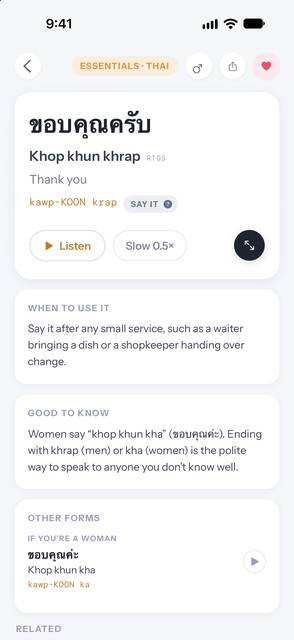
Thank you
Ευχαριστώ
Romanized Efcharistó
ef-khah-rees-TOH
Say it after any small service, such as a waiter bringing a dish or a shopkeeper handing over change.
-
Thank you very much
Ευχαριστώ πολύ
Romanized Efcharistó polý
ef-khah-rees-TOH poh-LEE
Use it when someone has gone out of their way to help and you want to show extra gratitude.
-
You’re welcome
Παρακαλώ
Romanized Parakaló
pah-rah-kah-LOH
Use it after someone thanks you. “No problem” is a more casual alternative.
Yes, the same word as “please”. Greek recycles it beautifully.
-
I’m sorry
Συγγνώμη
Romanized Syngnómi
see-GHNOH-mee
Use it to apologise when you’ve made a mistake or caused someone trouble.
Doubles as “excuse me”. One word covers both bases.
-
Yes
Ναι
Romanized Nai
neh
Useful for confirming a price or accepting an offer.
Yes sounds like “neh” and no sounds like “oh-hee” which famously confusing. A Greek “no” can also be a slight upward tilt of the head.
-
No
Όχι
Romanized Óchi
OH-khee
Use it to turn down an offer or an extra you didn’t ask for.
-
Okay
Εντάξει
Romanized Entáxei
en-DAHK-see
Use it to agree to a plan, a price, a meeting time or a pickup point.
-
Perfect
Τέλεια
Romanized Téleia
TEH-lyah
A warmer “okay” for when a suggestion suits you.
-
That works for me
Μια χαρά
Romanized Mia chará
myah khah-RAH
Use it to accept a suggestion, such as a later table or a different room.
Literally “a joy”, the Greek way of saying everything’s just fine.
-
No problem
Κανένα πρόβλημα
Romanized Kanéna próvlima
kah-NEH-nah PROH-vlee-mah
Use it when someone apologises to you, or to wave off a small inconvenience.
-
One moment, please
Μισό λεπτό, παρακαλώ
Romanized Misó leptó, parakaló
mee-SOH lep-TOH pah-rah-kah-LOH
Buy yourself a few seconds at the counter while you find your wallet or decide what to buy.
Literally “half a minute”, the standard Greek pause button.
-
Could you help me, please?
Μπορείτε να με βοηθήσετε, παρακαλώ;
Romanized Boreíte na me voithísete, parakaló?
boh-REE-teh nah meh voh-ee-THEE-seh-teh pah-rah-kah-LOH
The polite way to open a request for assistance.
Greetings
-
Hello
Γεια σας
Romanized Geia sas
YAH-sahs
An everyday greeting polite enough for staff and strangers. One of the first things you should learn in any language.
“Γεια σας” is polite or plural; “γεια σου” is for one person you know. Both literally wish good health.
- Casual Γεια σου Geia sou YAH-soo
-
Hi
Γεια
Romanized Geia
yah
The casual “hello” for friends and anyone you know well.
-
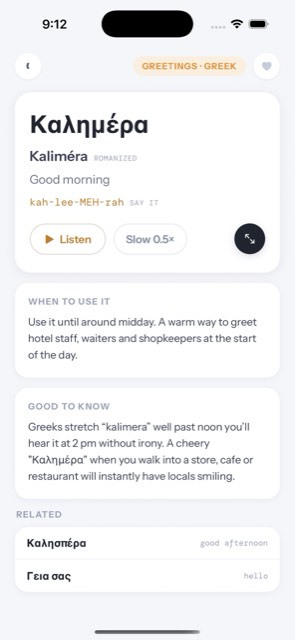
Good morning
Καλημέρα
Romanized Kaliméra
kah-lee-MEH-rah
Use it until around midday when you greet staff in a shop, café or hotel.
Greeks stretch “kalimera” well past noon, and you’ll hear it at 2 pm. Say it as you walk into a shop or café.
-
Good afternoon
Καλησπέρα
Romanized Kalispéra
kah-lee-SPEH-rah
For the stretch between lunch and evening. When people switch to “good evening” varies, so follow what locals say to you.
Greek jumps from kalimera to kalispera with nothing in between. From mid-afternoon onward this is your greeting.
-
Good evening
Καλησπέρα
Romanized Kalispéra
kah-lee-SPEH-rah
The greeting for later in the day: walking into a restaurant for dinner, or checking in after dark.
-
Goodbye
Αντίο
Romanized Antío
ah-DEE-oh
Say it as you leave a shop or get out of a taxi.
In practice Greeks mostly part with “γεια σας”, the same word that greets you.
- Everyday Γεια σας Geia sas YAH-sahs
-
See you later
Τα λέμε
Romanized Ta léme
tah LEH-meh
For people you’ll see again, such as hotel staff or the barista you visit each morning.
Literally “we’ll talk”, the beloved casual Greek sign-off.
-
Have a good day
Καλή συνέχεια
Romanized Kalí synécheia
kah-LEE see-NEH-khyah
A sign-off after a short exchange, such as paying in a shop.
Literally “good continuation”, the wonderfully Greek wish for whatever the rest of your day holds.
-
My name is [name]
Με λένε [όνομα]
Romanized Me léne [ónoma]
meh LEH-neh [OH-noh-mah]
It’s useful to introduce yourself in the local language, especially when meeting people during your travels.
-
How are you?
Τι κάνετε;
Romanized Ti kánete?
tee KAH-neh-teh
Follow your greeting with it. Some people answer briefly, others treat it as a real question.
- Casual Τι κάνεις; Ti káneis? tee KAH-nees
-
I’m well, thank you
Καλά, ευχαριστώ
Romanized Kalá, efcharistó
kah-LAH ef-khah-rees-TOH
The standard reply to “How are you?”. Ask the question back if you want to continue the conversation.
-
Nice to meet you
Χάρηκα
Romanized Chárika
KHAH-ree-kah
A useful phrase when meeting someone new on your travels. Saying it in the local language is a nice touch.
Literally “I was pleased”. The same form is used regardless of gender.
Also in the app
Nine more categories, 132 further Greek phrases:
- Communication 14
- Food & Drink 28
- Coffee 8
- Dietary 14
- Getting around 20
- Accommodation 14
- Shopping 10
- Emergency 17
- Social 7